
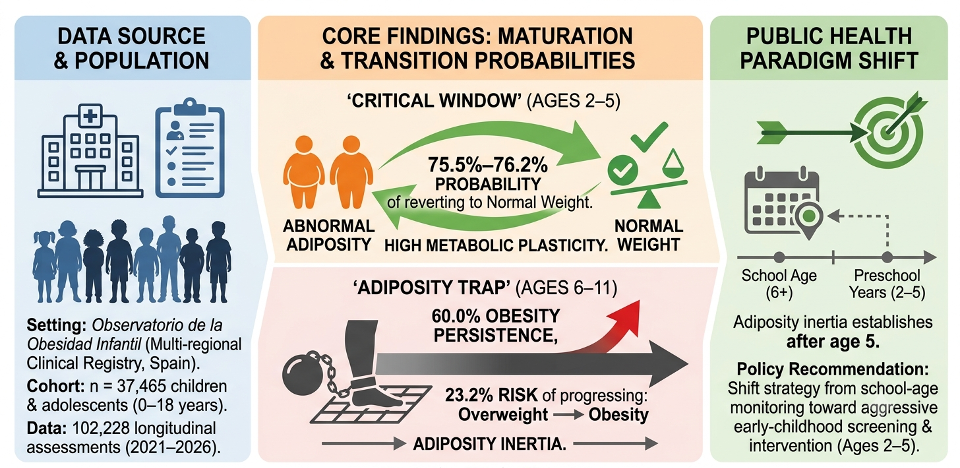
A breakthrough study of over 37,000 Spanish children reveals that while nearly all overweight toddlers (2-5 years) can revert to a healthy weight, this flexibility abruptly vanishes by age six.
The clinical narrative surrounding pediatric adiposity has long been centered on steady, often disheartening, persistence. However, a robust, longitudinal analysis of real-world clinical data, led by first author Juan Pablo González-Rivas (of CUHMED, HM Hospitales, and Harvard T.H. Chan School of Public Health) and colleagues, shatters this paradigm. Published in Nutrients, the study provides a new, mathematical map of adiposity progression, defining a fleeting «critical window» of near-universal plasticity followed by a rigid «adiposity trap.»
Modeling Fluidity vs. Inertia via Markov Chains
Standard epidemiological studies are typically cross-sectional snapshots, providing limited insight into individual metabolic trajectories. To address this, González-Rivas and his multi-regional team analyzed data from 37,465 children (ages 0-18) treated within the HM Hospitales «Observatorio de la Obesidad Infantil» in Spain between 2021 and 2026. This population contributed over 102,000 clinical visits.
The methodology utilized continuous-time Markov chain models—an intensity-based statistical framework—to calculate the probability of children transitioning between Body Mass Index (BMI) categories (Normal, Overweight, Obesity) over a one-year horizon, distinct from modeling simple mean trajectories.
The Crucial Findings
While baseline screening showed that over 20% of the cohort already presented with overweight or obesity, the true insight lay in the age-stratified transition probabilities.
1. The Critical Window (Ages 2-5): For children in this preschool cohort, weight status is highly dynamic. Regardless of whether a child entered this stage underweight, overweight, or obese, they demonstrated a remarkably homogeneous, 75% to 76% probability of reverting to or maintaining a normal weight by their last assessment. Obesity persistence was a mere 6%.
2. The Adiposity Trap (Ages 6-11): This flexibility closes abruptly. In school-aged children, category-specific persistence takes hold. For those categorized as obese, the probability of remaining so spiked to 60.0%. Critically, overweight children in this age group faced a severe 23.2% risk of progressing from overweight to obesity.
A clear visual of this metabolic «hardening» can be seen by comparing the trajectories of mean BMI z-scores across age groups:
2-5 years: All BMI categories showed dramatic regression toward the mean (convergence toward a normal z-score).
6-11 years: The obesity group z-score diverged upward, while others remained stable, indicating a statistical «diagnostic tracking.«
12-18 years: Trajectories stabilized across categories, though the obesity group showed some decline (from 3.2 z-score to 1.8), likely due to growth or increased autonomy.
Transition Probabilities to Normal Weight (NW) from Different Baseline Statuses:
| Baseline Category | Transition Probability to NW (2-5 yrs) | Transition Probability to NW (6-11 yrs) | Transition Probability to NW (12-18 yrs) |
| Underweight (UW) | 76.2% | 71.3% | 78.0% |
| Normal Weight (NW) | (Maintenance) | 90.6% (Maintenance) | 88.5% (Maintenance) |
| Overweight (OW) | 75.9% | 39.2% | 46.6% |
| Obesity (OB) | 75.5% | 12.3% | 15.8% |
Data represent 1-year transition probabilities estimated via continuous-time Markov models. (For full 95% CIs, see Table 2 in original manuscript.)
Clinical & Public Health Implications: Seizing the Preschool Window
This study offers a profound counterpoint to the passive ‘wait-and-see’ approach. The observed drop in metabolic and behavioral plasticity after age five confirms that early childhood (ages 2-5) is a finite therapeutic window that sequentially and causally leads to the adiposity trap if missed. This statistical construct operationally defines a pattern of strong diagnostic tracking where reversal becomes physiologically and behaviorally harder.
For pediatricians, these findings justify universal, family-based lifestyle interventions before the physiological architecture matures (i.e., around the adiposity rebound). Waiting to intercede until school age, when normalization probabilities are halved, delays critical multidisciplinary care during the most fluid phase of a child’s metabolic life.
The METRICS team concludes that public health strategy must recognize this brief opening to break the «trap» of severe pediatric weight outcomes.
Citation
González-Rivas, J.P.; Rodrigo-García, M.; Rodríguez Sánchez, A.; Díaz Conradi, Á.; Bosch, M.Z. Identifying the Critical Window and Adiposity Trap in Spanish Children: Longitudinal Evolution and Transition Probabilities of BMI Z-Scores from a Clinical Registry (2021-2026). Nutrients 2026, 18, 2455. https://doi.org/10.3390/nu18152455